mardi 13 mai 2008

A therapeutic cosmetic from Brocard in art nouveau style


A nice advertizing from Brocard about a therapeutic cosmetic, in a style of "art nouveau", which was in the course a century ago.
I found this image from this web site. It seems that those products did not be inferior to a quantity of "present" medicines. The text in Russian can give us more informations about the comparaisons related to "institutes of beauty".

Old soap advertizing from Brocard perfume industry

Two old advertizing from Brocard about probably the "national soap".
Henry Brocard contributed introduced an hygienic revolution in Russia with one soap for one kopeck. Before that period, soap and beauty stuff were too expensive for the whole population in the empire.
Brocard sold millions of soap in the old Russia, developping the history of the "national soap".
This first successfull experience encouraged Henry Brocard to diversify the soap's offer with more sophisticated formulas including glycerine, Mai fleuri, concombre, amber...

mardi 11 mars 2008

A great Russian embriodery from the Brocard collection


I would like to share with you this nice embroidery, collected by the Brocard family probably around 1870 in Russia. The Brocard's marketing was really impacting the culture of embroidery making in Russia by inserying in each packaging new enthousiatic design patterns.

All families were trying to produce those designs into the private producting durably influencing the creativity in this kind a hand made art in the whole old Russian Empire.

This exemple is really characteristic with a great mix of white cotton and colored silk and symbolic myths around birds, othodox church, and men trying to convert other to the religion.
This nice and rare work was probably sed into a church. Although its age, this piece of embroidery is really in great condition, emphazing the large perimeter of what Henri Brocard was collecting at this time, from the flemish primitive paintings to the old russian traditionnal objects and memories.

jeudi 6 mars 2008

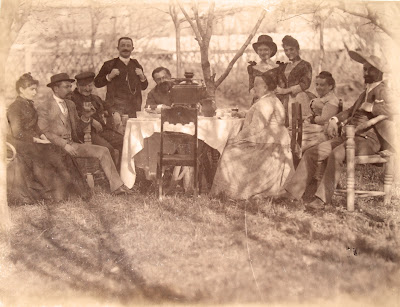
The Brocard's windmill in Moscow about 1890

© Family Brocard & Roure

The Brocard family in Mosow about 1890, with at the center Henri and Charlotte Brocard, founders of the Brocard industry and great inventor of Perfume in the Russian Empire.
We can also recognize Eugénie Brocard and Georges Félix Ferrand, who were also working into the company. Eugénie tried after the Russian revolution to relaunch the Brocard perfume industry in France at Saint Brice la Forêt, but a terrible fire destroyed their dreams.

Their daughter Henriette Ferrand is also visible closed to her father. Henriette will be married to Jean Roure in France, who will inherit a part of the Roure perfume industry in essential oils and absoluts.

Others members of the Family are gathered on the picture as Auguste Ferrand and his wife, the related Giraud family, and other Brocard's children as Alexandre and Emile who will work in the perfume industry. Alexandre, especially will continue to ensure the direction of the company after the Russian revolution until 1920 or 1922.
Three wet-nurse are also on the photography with the younger members of the family. You can recognize them with something which is looking like a diadem on their hairs.

This windmill, probably only decorative was at the end of the Brocard property in Moscow, closed to the plant.

mardi 26 février 2008

Old Russian embroidery mixing silk and cotton

This embroidery is a mix of cotton and silk designing in blue and red, a nice clothe for a small girl. We can estimate that it was produced at the end of the XIXe century or at the early XXe.

The region of origin is very difficult to specify without a specific expertize on the subject.
But I am expecting some reactions and potential advice from the nice Blog of Eugene Baryshnikov, "Ethnography of Belarus".

I will try to share information each month on the Brocard's blog. See you soon.

lundi 14 janvier 2008

Happy new year with a nice Russian Art deco picture


A nice invitation from the old Russia looks like a print version of the Art Deco period. But regarding the year 1903, we need probably to connect it more to the Art Nouveau time.
I like the design of it, the marvelous architecture of the house behind, as the police used with a nice mix of grey, silver, green and brown.

Even if I am not re-opening the blog now, I would like to seize the opportunity to wish you an happy new year, inviting you to have a look on my another blog about some collections and especially in the last posts about some "aquarelles" from the conquest of Algeria in 1830.

lundi 17 décembre 2007

L'art des datchas revit dans une étoffe brodée

I would like to thank all our visitors and especially our friends from Russia who took the time to read those news about the Brocard family and share their knowledge with us by mail. The blog will be closed for a period of time, but we will come back in the future. :-)

Cette dernière étoffes me permettra de fermer le rideau du Blog provisoirement, comme ce fut le cas également du blog "Sur les pas d'une collection".

J'admire comme sur cette photo ce travail de broderies sur coton. Les griffons, les coqs, les aigles symbolisés reprennent une parte du bestiaire russe. L'homme est également visible comme par une guirlande de femmes vêtues de masques et de curieuses plumes de chaque côtés du visage.

S'agissait-il d'une nappe, d'un napperon figurant un meuble ? A n'en pas douter, il rejoint à nouveau l'art populaire russe et celui des figures propres à l'artisanat des datchas. Cela ne reste qu'un morceau de coton mais avec lui revit une partie de l'ambiance et de ce style de vie à la fin du XIXe siècle.

technorati tags:

Un tablier en coton russe du 19e siècle flirte avec l'art


L'art populaire russe est sans limite. Ces figures et broderies, figurent sur le bas d'un tablier en coton. J'imagine la femme qui devait porter une telle oeuvre lors de ses travaux ou de son service. Le carrosse est symbolisé, le cheval suggéré. On pourrait y voir une création gauloise sur une monnaie d'un autre temps. Le mouvement pourrait préfigurer un bestiaire à la Matisse. L'oeuvre date probablement du XIXe siècle. Elle est juste disposée dans la partie la plus fragile du vêtement, qui devait s'accrocher aux meubles lors des activités. Cela constitue une forme de raffinement dans la simplicité en lien avec le folklore des traditions russes. En un mot magnifique.

technorati tags:

Broderies florales russe complexes sur du coton éphémère

Du haut de ce morceau de tissu en coton se succèdent des vagues successives rouges de plus en plus rapprochées, pour offrir sur un pan entier un subtile travail floral de broderies. Les pigments sont complexes. Le rouge, l'orange, le bleu, le jaune alternent entre croisillons et figures géométriques. Cette réalisation des provinces russes date sans doute d'une période située entre la fin du XIXe siècle et les débuts de la guerre de 14.

technorati tags:

Un tissu en soie d'apparat brodé de fils d'argent


Sur cette étoffe en soie, se dessinent différents motifs brodés de fils d'or et d'argent. Dans la partie centrale, ce sont comme des petits cailloux juxtaposés habilement, donnant comme un effet de galuchat, un peu art déco.
Sur les deux côtés, des entrelacs floraux, de paillons et de guirlandes, impriment un mouvement plus classique.
Quel était l'usage de ce tissu d'apparat ? Ornait-il le "plastron" d'une homme ou d'une femme ? A quelles occasions était-il revêtu en Russie ? Le mystère reste. Les références documentaires manquent. A moins que vous ayez des idées ?

technorati tags:

samedi 15 décembre 2007

Vue du salon Brocard-Ferrand autour de 1880 à Moscou


Sur cette photo fort difficile à améliorer tant le temps a injurié les teintes et contrastes. cependant après quelques tentatives sous Photoshop, j'arrive à mieux aviver les détails et nuances.

Nous sommes dans le salon d'une propriété d'Eugénie Ferrand, née Brocard, probablement autour de 1880, à Moscou. C'est une vue intime, chaleureuse de la famille Brocard, grand parfumeur du XIXe siècle.

Sur la gauche, Henri Brocard, est debout devant trois petits tableaux et semble lire un papier. Il est le fondateur de la parfumerie éponyme, lancée en 1864 à Moscou. Sur la droite, debout près de la chemniée se trouve Georges Félix Ferrand, son beau-fils. La dame assise à ses côtés est sans doute l'épouse d'Auguste Ferrand, lui même assis à côté. Ils sont tous les deux assez jeunes.

La vieille dame assise au premier plan sur un fauteuil de style Louis XVI, a élevé tous les enfants Brocard. Il s'agit de tante Mina Koch, adoptée dans la famille après toutes ces années de service.

Tout à fait à gauche sur la photo, aux pieds de l'ange, se trouve une petite fille de 4 ou 5 ans. Elle devrait pouvoir aider à dater plus exactement cette vue. Il s'agit d'Henriette Ferrand, une de mes arrière-grand mères du côté de mon père. Sa maman, Eugénie Brocard l'enlace sur ses genoux.

Devant Henri Brocard, se trouve sans doute Charlotte Brocard, son épouse, née Raway, d'une famille Belge de Spa, dont la famille était directeur des pension-écoles pour les jeunes enfants fortunés des familles européennes.

On peut remarquer sur cette vue quelques tableaux de la collection Brocard, donnés par Henri à sa fille. Tous ou presque travaillent dans l'industrie des parfums à Moscou, dans l'usine familiale.

Intimist view of the red place in Moscow closed to 1890

Another picture of the "place rouge" in Moscow closed to 1890. The black or blue balloon can help to define the period. Probably it was a special day at this time. Or a special birthday or another celebration... It will need more investigations.

By the way, I really like the spirit of the old Russia which is perceptible on this place. The clothes of the people. The face of the old man at the first plan, the violonist... The women probably singing the old song evoked by the musicians.

This place is still today very large with an impressive perspective, but through this picture, we have a closed view, as being in a small community or village in the center of Moscow, at this time.

Art Nouveau design and extravagant Russian invitation

This nice paper can be an invitation at the beginning of the century, in 1902, or the memory of an event concerning this wife and men ? Unfortunately I am not able to read it. In any case, the design is incredible with all those magnificent form of the "art nouveau" period.

The quality of the paper is also perfect which is great for such a souvenir of this time, after the revolution.
Somewhere, this is fantastic to imagine the common trend of the "art nouveau" style in whole Europe including Russia with some extravagances given by the tradition and the culture there.

We can observe there a real complexity of flowers, mix of colors, creativity in the way to present two old photographies.
The tree or something which is resembling, seems connected to a dream like a vivid vegetable.

If you are able to give us more information about, especially our Russian readers, do not hesitate. ;-)

samedi 8 décembre 2007

Antiquities market on the Red Place in Moscow about 1880

Henry Brocard, great collector at this time, before 1900, was searching on the Russian market antiquities. It was a great period for that. The young aristocrats were inheriting their parents a lot of old objects coming from centuries of collecting. But as the time was difficult and not so stable, some of them were deciding to sell those marvelous testimonies of the past.

Henry, using a part of his fortune generated by the perfume industry, was buying in the whole perimeter of the Russia Empire, some traders helping him to identify what was interesting.

He was also walking on the market in the "red place" in Moscow. This nice picture probably about 1880, is emphasing the ambiance there and the opportunity to collect exiting objects from the Russian tradition or famous old painters. One legend in the family is stressing that Henry found a painting of Dürer in this market. I am dreaming about such a discovery like this...

dimanche 2 décembre 2007

Creativity in art deco period in Russia

Well this is a long day. And I have not been updating the blog for a long time. So I am seizing the opportunity to share more news during this week-end.

This interesting post about a Russian art deco design can have some interest, representing again the old symbols of the Russian Empire with a very inventive approach.

technorati tags: